What Odds work on Cricket Betting? Simple explanation
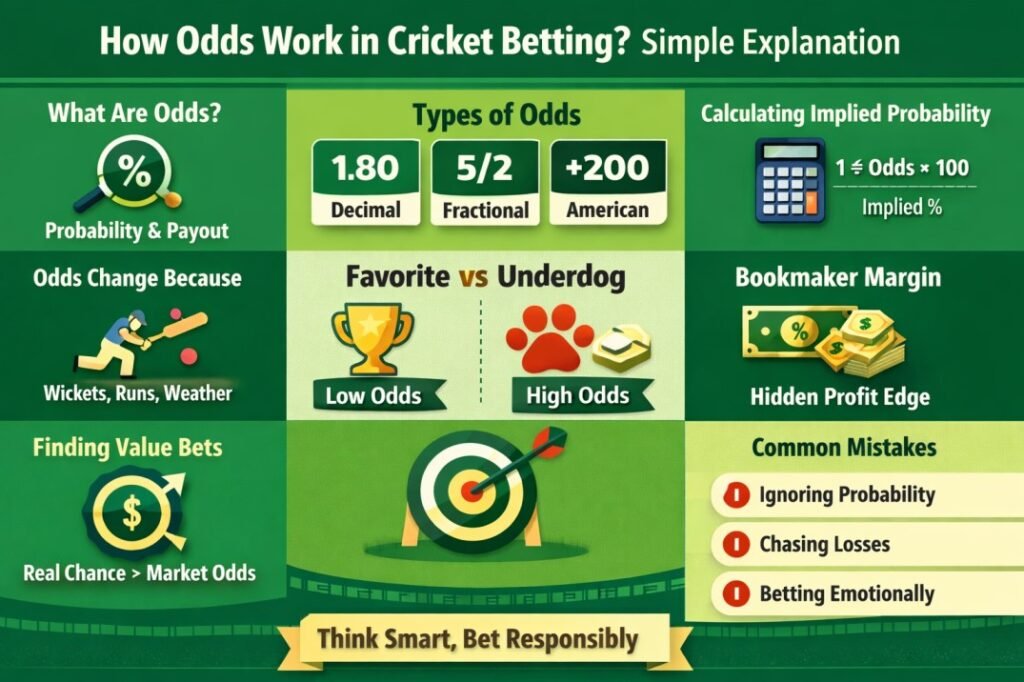
Understanding how odds function is the basis of an informed betting on cricket. When someone is watching an IPL Test event at Narendra Modi Stadium or a high-voltage IPL game the numbers that are displayed next to every team’s score provide a complete picture. Online Cricket ID Whatsapp number Odds aren’t random figures. They are a reflection of the market demand, probability and the risk evaluation.
If you are able to interpret and calculate odds accurately then you can go from guessing to taking structured choices.
What are Betting Odds?
In simplest terms the word “odds” refers to two aspects:
- The chance of a certain result happening
- The possible payout in the event that this result happens
For instance for example, if Team A is given 2.00 odds of winning and the market is suggesting they have a roughly 50 percent implied probability (explained in the following). If Team B’s odds are 1.50 The implied probability is greater, that is, they are more likely to be successful.
Odds are basically the price system used in markets for betting.
The Three Common Odds Formats
The majority of betting platforms for cricket use three different formats:
1. Decimal Odds (Most Used in India)
This is the simplest form.
- Example: 1.80, 2.50, 3.20
- The calculation is: Total Return = Stake
If you place a bet of Rs1,000 with 2.50 odds: Rs1,000 multiplied by 2.50 = Rs2,500 return total (Rs1,500 profit)
The odds for decimal games already incorporate your initial stake
2. Fractional Odds (Traditional Format)
The situation is quite common across the UK.
- Example 5/2 (read as “five to two”)
- The profit is (Stake x Numerator/Denominator)
At 5/2, Rs.1,000:
Profit = Rs.2,500
Total return of Rs.3,500 (including stake)
3. American Odds (Moneyline Format)
Not as common in cricket, but widely used.
- +200 means that you earn 200 percent of the stake
- 150 means that you must place a bet of Rs150 in order to win Rs100.
Decimal format is still the easiest to comprehend for the majority of cricket punters.
How do bookmakers calculate odds?
Odds are usually determined by probability. Bookmakers study:
- Form of the team
- Player availability
- Head-to-head records
- Conditions for pitching
- Forecast for the weather
- History of the venue
For instance, in places that are batting friendly, such as Wankhede Stadium. Wankhede Stadium, teams batting second could be slightly more likely to win because of the chasing advantage historically seen there.
Bookmakers convert their estimate of probabilities into odds.
Understanding Implied Probability
Implied probability lets you know what the odds really suggest.
Formula (Decimal Odds):
Implied Probability is 1 * Decimal Odds x 100
Example:
If the odds are 2.00
1 1 2.00 100 = 50 percent
If the odds are 1.50
1 1 1.50 100 = 66.6 percent
If the odds are 3.00
1 1 3.00 100 = 33.3 percent
This is a reference to:
- 1.50 odds = strong favorite
- 2.00 odds = equally equal odds
- 3.00 odds = underdog
Understanding implied probability lets you assess whether the market could be overvaluing or undervaluing a particular team.
What causes odds to change during the course of a match
The markets for betting on cricket are constantly changing. The odds change as new information continuously enters the game.
For instance:
- The key batsman is out in the early hours
- The bowler can take two wickets in one go
- Rain helps reduce overs
- The required run rate rises dramatically.
In live games live games, odds are updated ball by ball.
Imagine the scenario of a T20 match played in the IPL. If a team is required to score 60 runs from 30 balls, with eight wickets left the odds could remain in balance. If it’s 60 runs in 24 balls, with only three wickets remaining, the odds change drastically.
This is referred to as live betting or in-play movement.
What is The Bookmaker Margin?
Bookmakers do not just provide “true probabilities” odds. They offer margin (also known as overround).
Example:
When two teams have been found to be completely identical, the odds are 2.00 each (50 percent plus 50 percent).
The bookmaker could also make available:
- Team A 1.91
- Team B 1.91
Implied probabilities:
1 1.91 / 1.91 100 = 52.35 percent
Probability of combining = 104.7%
The extra percentage represents the margin for the bookmaker. It guarantees profit over time.
Knowing this will help you realize that odds are altered to favor the player.
Favorite vs Underdog
- Favorite Probability: Lower odds, greater probabilities
- Underdog: More odds, less likely
International tournaments that are hosted by the International Online Cricket Betting ID Council, strong teams are often viewed as favorites to win. However, the nature of cricket implies that underdogs may be a good option under certain conditions, particularly in shorter formats.
How to Determine Value in Odds
Bettors who are experienced don’t just consider who is most likely to take the prize. They search at an investment.
Value is created in the following situations:
Your estimated probability is greater than the implied market probability
Example:
The market has the odds at 2.50 (40 percent probability).
If you think that the team is at a 50% possibility, then that bet is of merit.
Over time, consistency in value-based decisions are more important than the short-term gains or losses.
The importance of data in the modern age of Odds
The current cricket odds are based heavily on statistics. Platforms evaluate:
- Rates of strike
- Bowling economy
- Powerplay performance
- Death-over efficiency
- Stats specific to the venue
- Toss impact trends
For instance, in venues that are suited to spin, such as for instance the MA Chidambaram Stadium, teams who have strong spin attacks could start off with less chances.
Adjustments based on data are now the key for ensuring that markets are priced accurately.
Common Mistakes Beginners Make
- Bet only on favorites since they “look like they are safe”
- In the absence of implied probability
- Reacting too quickly to short-term changes
- Not understanding margin
- The total return is often confused with net profit
It is important to look at odds logically, not emotionally.
Responsible Perspective
The game of cricket is a financial gamble. The odds do not guarantee the outcome as they are based on probability evaluations. Even a team with a price of 1.20 (over 80percent implied probability) is liable to be a loser.
Understanding the odds helps make decisions easier However, discipline and budgeting are essential.
Final Thoughts
Odds are just a mathematical expression of probabilities that is paired together with the concept of risk price. Once you have broken them down to implied probabilities and payout calculations, they are simple to comprehend.
Instead of viewing the odds as unreliable numbers instead, think of them as structured data. The more you know about the concepts of probability, margin along with value, the better informed your decisions will be.
Cricket is by nature unpredictable. This uncertainty is the reason the odds can fluctuate and that’s why knowing the way they function is crucial prior to putting any bet.
If you approach the challenges with a clear mind, data-driven awareness and discipline, you can move from guesswork into informed participation which is the best strategy.