Understanding the Difference: Bookmaker IDs vs Betting Exchange IDs
If you’ve spent time exploring the current online betting world you’ve likely come across two distinct types of accounts such as those with the Bookmaker ID and the Exchange ID. Both serve as your entry point to the world of betting but they operate under completely different strategies, business models and user-experiences.
The distinction between the two is not only about technical terms; it’s the difference in placing bets against an organization and betting in conjunction with other players.
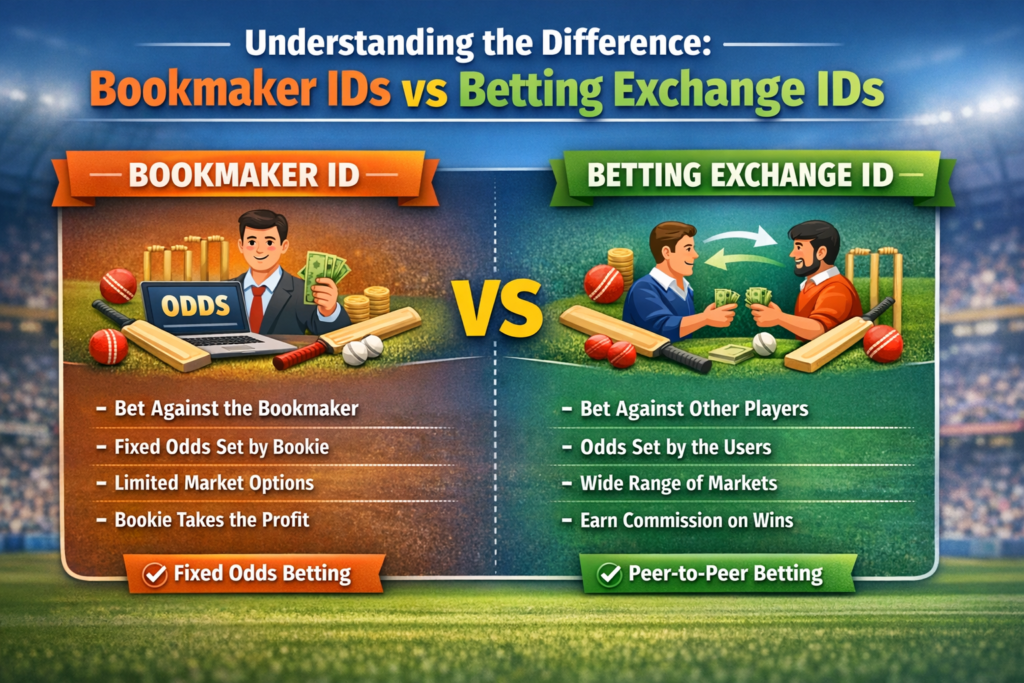
The Bookmaker Id: Betting Against the House
The Bookmaker ID gives you access to an old-fashioned sportsbook. If you make a bet at Bookmaker, you’re signing a contract directly with the operator – the “house.”
In this situation the bookmaker acts as an insurance company. Online Cricket ID Whatsapp Number They work with teams of traders and employ sophisticated algorithms to determine the odds, which include the terms “vig” and a “margin.” This guarantees that mathematically speaking, the bookmaker has advantage over users who are average in the long-term.
Key Characteristics
- Fixed Odds This is the amount you pay. After you hit “Place Bet” the odds will be set.
- The convenience: Bookmakers are designed for the novice user. They provide a vast menu of parlays, prop bets and “same-game” builders which are easy to navigate.
- Promos These are the areas where bookmakers excel. They employ aggressive marketing strategies, promotions, deposit bonuses, and bonuses for free bets to attract and retain customers.
- Account Limiting It is by far the most crucial part that is part of your Bookmaker ID. If a user has an ability to consistently beat the last line, bookmakers typically limit accounts, restricting the stake limit to a small amount.
The Exchange ID: Betting Against the Market
An Exchange ID provides access to an online peer-to-peer (P2P) betting platform. Consider this less of betting and more as trading on a stock exchange. It is not a bet against a particular operator, but the stakes are against the other users.
If you are using one of the exchanges, the site serves solely as a facilitator. They don’t decide the odds, the market decides. If you are willing to place bets on a team to win, another will be willing to place bets on the team to lose.
Key Characteristics
- Laying and Backing: This is the fundamental function in an exchange. There is the option to “Back” any outcome (betting that it will occur) as well as “Lay” the outcome (betting that it will bet that it will not occur, effectively acting as a bookmaker).
- Dynamic Odds Since odds are driven by demand and supply (liquidity) They change in real-time depending on the amount of cash entering the market.
- Commission-based: Instead of building an edge into chances, the exchanges usually make a small share (commission) on the profits from every transaction.
- Zero-Nonsense: The exchanges are generally not concerned whether you lose or win. They earn money from volumes. They do not limit accounts on the basis of winning streak and are the preferred platform for professional bets and traders.
Side-by-Side Comparison
To clarify the distinctions To help you understand the distinctions, here’s how the two IDs are compared against the various metrics that are most important to bettors who are active.
| Feature | Bookmaker ID | Exchange ID |
| Counterparty | The Sportsbook (The House) | Other Users (Peer-to-Peer) |
| Pricing | Odds calculated by an operator (includes the margin) | Market-driven odds (supply/demand) |
| Market Variety | Extensive (Props, Specials, Parlays) | Concentrated on the main markets (Winner and Totals) |
| Strategies | Traditional betting | Trading, Hedging, Laying |
| Account Longevity | Is vulnerable to “limiting” in the event of success | Very high, rarely prohibited |
| Fees | embedded in the odds | Commission Net profits |
Which One Should You Use?
It’s a matter of choosing between the Bookmaker ID and an Exchange ID. Bookmaker ID and an Exchange ID generally depends on your individual betting style and objectives.
When should you make use of an Bookmaker ID
If you like the entertaining aspect of betting , like building complicated parlays, playing specific sports, or benefiting from sign-up bonuses–a Bookmaker ID is probably to be the best choice. Its user-friendly interface is generally more user-friendly, and the number of “fun” betting options is much more extensive than those offered on exchanges. For those who are casual about sports, Bookmaker ID is the best option. Bookmaker ID is the standard.
When should you make use of an Exchange ID
If you consider betting on sporting events as game-based trade or an investment and require the Exchange ID. The capability for you to “lay” outcomes can be an excellent tool for hedge current positions or trading price fluctuations prior to the game begins. Additionally, if you’re planning to place large bets or use a professional-level strategy the absence of restrictions on accounts for the exchange is not negotiable.
How to be a professional: why Doesn’t It Work? Both?
A lot of experienced bettors don’t really choose one betting option instead of the other. Instead, they keep both.
Professional bettors typically employ the Lords Exchange ID to identify the “true” market price (because the exchange is a reflection of the consensus of the market better). They use the Bookmaker ID to look to find “value,” looking for instances in which the bookmaker is slow in adjusting their prices in relation to the exchange.
In the end the fact is that both IDs are both tools. An exchange ID and a bookmaker ID are both tools. Bookmaker ID is a tool for entertainment and enjoyment as opposed to an Exchange ID is a tool for analysis of markets and professional trading. Understanding the mechanism behind each will be a first move towards becoming a more knowledgeable and competent user of the betting system.